Clear Ice or White Ice: Features and Uses
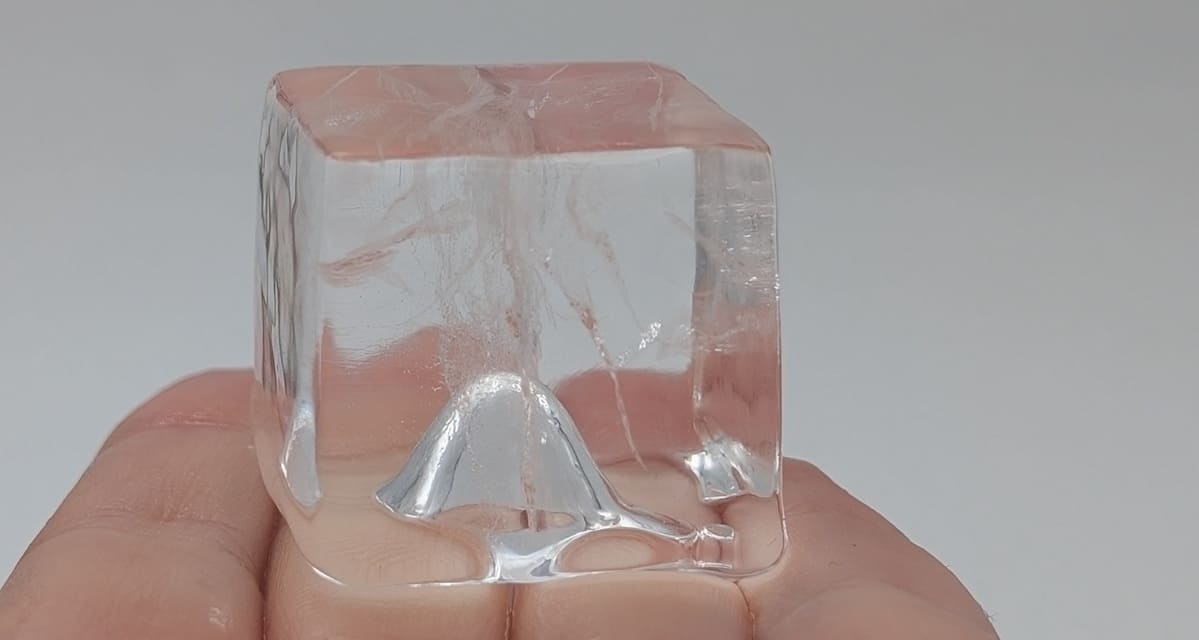
Clear ice and white ice are two types of ice that differ mainly in their internal structure, density and behaviour when melting. While clear ice is more compact and steadier, white ice contains air and impurities, making it more fragile and with a higher dilution.
The difference is not only in appearance. It has a direct impact on mixology performance, dilution control and the overall drinking experience. At Icetech, we’re going to tell you about the main features of these two types of ice and how they differ.
What is the main difference between clear ice and white ice?
The difference between both kinds of ice resides in how it is formed during the freezing process
Clear ice is formed when water freezes gradually and in a controlled manner, forcing air and impurities out in a single direction. As a result, we obtain a solid, uniform and visually clean structure.
However, white ice is formed when the freezing process is quick and disorganised. Air and minerals get trapped inside of it, rendering that characteristic opaque appearance.
In practical terms:
- White ice is denser and more compact.
- White ice has more air inside of it.
- Ice structure has a direct impact on its behaviour in the drink.
How different types of ice affect your drink
The role of ice is not limited to its appearance; it has a direct impact on the cocktail and the experience it offers to the costumer.
Clear ice melts more slowly. This helps to maintain the temperature of the drink without altering it too much, making it ideal for many cocktails that need to be served over time without becoming watered down.
Conversely, white ice tends to melt more quickly. Since it contains more air, its’ structure is less steady, speeding up the dilution process.
This results in:
- The drink cooling down quickly but losing its intensity sooner.
- The flavour becoming diluted in less time.
- Less control over the final result.
The quality of the water used in ice production is key, since it influences both security and the final results. this is regulated by bodies such as the Spanish Food Safety and Nutrition Agency within the food sector.
When should clear ice be used?
Clear ice is used when we are looking for accuracy and steadiness in the drink. It is perfect for classical or premium mixology, short drinks where dilution is not expected or services where appearance is important.
In these cases, ice does not only cool, it must also keep the cocktail’s balance for more time. If you are looking for an ice machine that generates professional-looking ice cubes, rely on Icetech.

When should white ice be used?
White ice remains the most widely used type in the hospitality industry, particularly in high-volume settings that need to supply large quantities, where rapid cooling and ease of production are prioritised. This type of ice does not require such strictly controlled processes as clear ice.
It is used in:
- Mixed drinks and soft drinks.
- Quick service outlets.
- Environments where precision is not a priority.
In some of these contexts, greater dilution is not a problem but may even be part of the desired outcome.
Common mistakes when choosing the type of ice
A very common mistake is to assume that clear ice will always improve the result. In a high-volume service, it is impractical and may not make any significant difference worth the effort.
It is also very common to overlook the quality of white ice. Not all ice cubes are the same: their density and formation process have a much greater influence than it might seem.
Finally, it is common not to adapt the ice to the type of drink. If we use the same format for everything, it is true that we will simplify operations, but we will also greatly limit the quality of the result.
What determines the quality of ice?
Beyond whether it is clear or white, the quality of ice depends on several technical factors that influence its behaviour.
These are 4 basic parameters:
- The quality of the water used.
- Control of the freezing process.
- The type of machinery.
- The amount of air in its structure.
These elements determine whether the ice will be steady, neutral in flavour and suitable for professional use.
Frequently asked questions about clear and white ice
In the day-to-day running of a bar, many decisions regarding ice are not based on theory, but on experience and the problems that arise during service. These are some of the most common queries in real-world situations.
Why does ice melt much faster in some bars than in others?
This is usually due to the density of the ice. If it contains more air (low-quality white ice), it melts sooner and causes more dilution. The ambient temperature and the temperature of the glass also play a role.
When is it worth using clear ice in a real-world setting?
It makes sense when you want to control dilution for longer, such as in short cocktails or premium drinks. In fast-paced or high-volume service, the difference may not be worth it operationally.
How do I know if the ice I’m using is good quality?
Good ice is compact, doesn’t break easily and doesn’t alter the taste of the drink. If it melts too quickly or leaves residue, it’s usually a sign of poor quality or poor formation.
Is it worth switching to a different type of ice in a high-volume bar?
It depends on the bar’s concept. In quick service settings, good white ice is sufficient. In more refined cocktail bars, the type of ice forms part of the value proposition.
Clear ice and white ice differ in their internal structure and behaviour in the drink. Clear ice is denser, contains less air and melts more slowly, allowing for greater control over dilution. White ice, on the other hand, is more porous, cools quickly and is more practical for high-volume service.
The choice between the two does not depend on aesthetics, but on the type of drink, the pace of service and the level of control one wishes to have over the final result of the cocktail.
If you’re looking to buy a professional ice machine and would like us to offer you personalised assistance, contact us.